Imagine a Man who can calm a hurricane with a whisper. A Man who can command the molecular structure of water to support His footsteps. A Man who can reach into the cold grip of death and pull a soul back into the light.
Most of us know Jesus as the Gentle Shepherd. We know Him as the healer of lepers and the friend of sinners. But have you ever seen the side of Him that makes the mountains tremble? Have you ever witnessed the authority of the Creator when He encounters a lie?
On a dusty road between Bethany and Jerusalem, in the final week of His life, Jesus Christ did something that left His closest friends paralyzed with fear. He didn’t heal. He didn’t bless. He didn’t multiply.
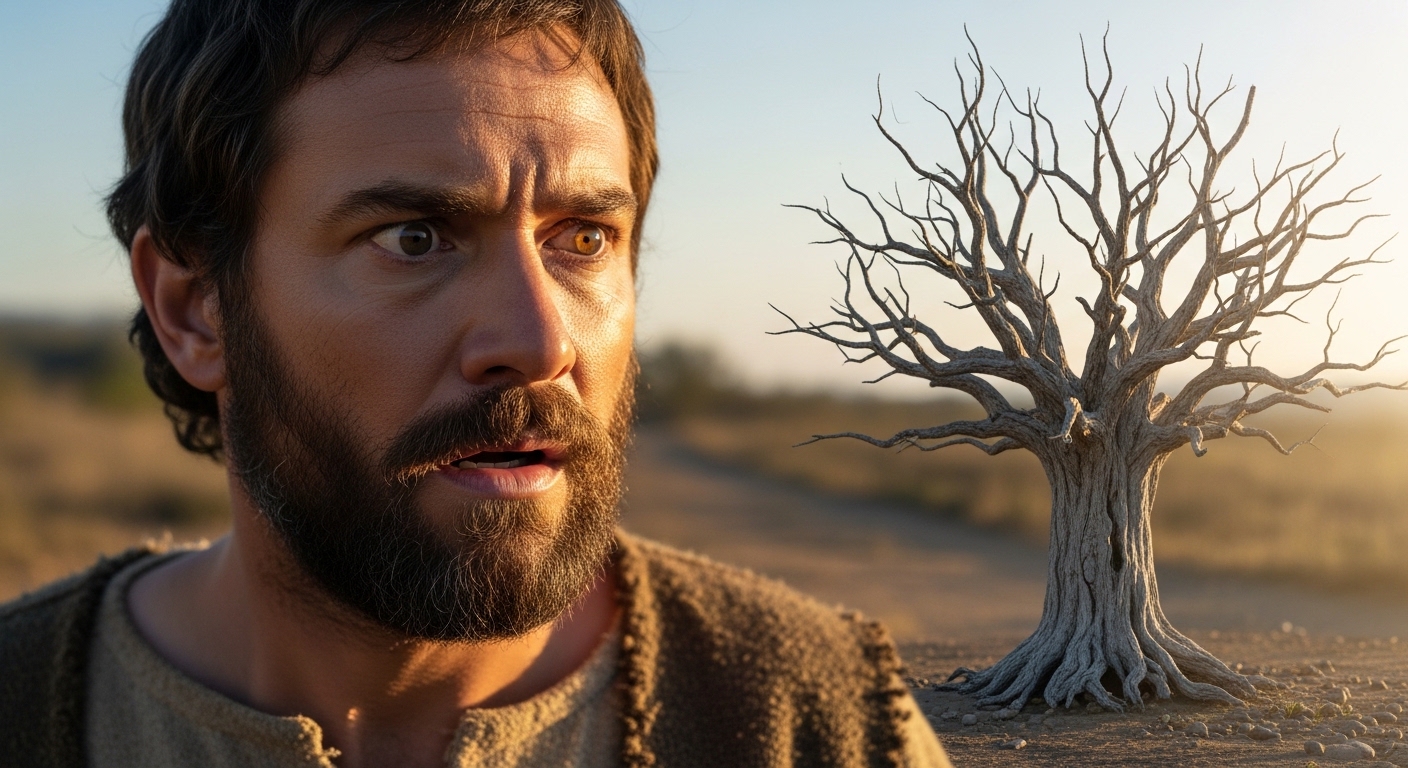
He looked at a living, breathing organism—a fig tree—and He spoke a sentence of death.
Within twenty-four hours, that tree was not just wilted. It was scorched from the roots up, as if hit by a bolt of invisible lightning.
Why would the Prince of Peace kill a tree? Was it a fit of human temper? Or was it a terrifying prophetic warning that echoes down through two thousand years to you, sitting there right now?
Before we dive into the heart of this mystery, I have to ask you: have you ever felt like you were “performing” your faith? Looking the part on the outside, but feeling empty on the inside? If you’ve ever struggled with spiritual authenticity, type “Search my heart” in the comments right now.
Stick with me, because what Jesus does next in the Temple will explain exactly why this tree had to die—and it might just change the way you look at your own life forever.
CHAPTER 2: THE ATMOSPHERE OF REBELLION
The air in Jerusalem was thick. It wasn’t just the heat of the Judean sun; it was the friction of a city on the brink of an explosion. It was Passover. Millions of pilgrims had descended upon the city. The smell of roasted lamb, incense, and unwashed thousands filled the narrow corridors.
But beneath the festive surface, a war was brewing. The Roman governors were nervous about a riot. The religious elites—the Pharisees and Sadducees—were terrified of losing their power. And in the center of it all was Jesus of Nazareth.
He had just entered the city on a donkey, fulfilling an ancient prophecy. The crowds had screamed “Hosanna!” They had laid down palm branches. They treated Him like a conquering King.
But Jesus wasn’t looking at the crowns. He was looking at the hearts.
He spent the night in Bethany, a small village on the slope of the Mount of Olives. Bethany was the home of His friends—Mary, Martha, and Lazarus. It was His sanctuary. But as the sun began to peek over the horizon on Monday morning, Jesus was already on the move.
And here is the detail the Bible gives us that changes everything: He was hungry.
Think about that. The One who created the very concept of hunger, the One who fed five thousand with a few loaves of bread, felt the gnawing emptiness in His own stomach.
Does it surprise you that God can be hungry? It shows His humanity. But as we’re about to see, His hunger was about more than just a physical craving. He was hungry for something the world wasn’t giving Him.
Pause for a second. Have you ever considered that God is “hungry” for your devotion? Not because He needs it, but because He loves you? If this thought moves you, drop a 🙏 emoji in the comments.
But wait… as Jesus walks down that road, He sees something in the distance. A green beacon in a sea of brown. And what happens next is the first “Open Loop” of our story.
CHAPTER 3: THE DECEPTION OF THE LEAVES
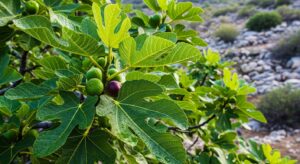
From a distance, the tree looked magnificent.
In the climate of Israel, fig trees are unique. Usually, the fruit—small, edible buds called taksh—appears at the same time as the leaves. If you see a fig tree covered in lush, vibrant foliage, it is an biological “promise” that there is food to be found.
Jesus saw the leaves. He saw the promise.
He stepped off the path. His disciples followed, perhaps whispering among themselves about the day ahead. They watched as their Master approached the tree. He reached into the branches, moving the broad, sandpaper-textured leaves aside.
He searched.
Nothing.
He moved to another branch.
Empty.
The tree was a liar. It had the appearance of life, the clothing of fruitfulness, the “branding” of a healthy tree—but it was a hollow shell. It was using all its nutrients to produce leaves to impress people from a distance, but it produced nothing to satisfy the hunger of the Traveler up close.
What would you do? Most of us would be disappointed. Maybe we’d mutter a complaint and walk away.
But Jesus does something that sounds almost… irrational.
He speaks to the tree. He doesn’t just speak; He issues a decree. Mark 11:14 tells us He said: “May no one ever eat fruit from you again.”
The disciples heard it. They looked at each other. Did He just curse a tree? It seemed so out of character. Why waste words on a plant?
But remember what I told you: this wasn’t about the tree. The tree was a mirror. And what Jesus was about to do in Jerusalem would prove that this “curse” was actually a funeral sermon for a dying religion.
Because in just a moment, we’re going to see Jesus walk into the Temple and start a literal riot. And if you think the tree story is intense, you haven’t seen anything yet.
Before we move to the Temple, ask yourself: Is your life full of “leaves” but no fruit? Are you busy with religious activities but lacking love? Comment “I want to be fruitful” if you’re seeking a deeper walk.
CHAPTER 4: THE CLEANSING OF THE CORRUPTION
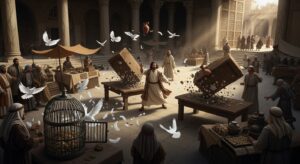
Jesus leaves the withered-but-still-green tree and walks straight into the mouth of the lion. He enters the Temple of Jerusalem.
Imagine the scene. This was supposed to be the “House of Prayer for all Nations.” But as Jesus walked through the Court of the Gentiles, He didn’t hear prayers. He heard the shouting of currency traders. He heard the bleating of sheep and the cooing of doves being sold at extortionate prices.
The religious leaders had turned the worship of God into a “pay-to-play” scheme. They were the “leaves” of the fig tree. They looked holy in their long robes. They had the beautiful Temple. They had the rituals.
But they were barren.
Jesus doesn’t just watch. He acts.
He grabs cords and weaves a whip. He starts flipping tables. The sound of heavy wood hitting stone echoes like thunder. Coins—the lifeblood of the corrupt system—scatter across the floor.
“My house shall be called a house of prayer,” He bellows, His voice shaking the very foundations of the porch, “but you have made it a den of thieves!”
Do you see the connection?
The Fig Tree had leaves but no fruit.
The Temple had ritual but no righteousness.
The Tree was a living parable of the Temple. By cursing the tree, Jesus was saying: “This system is over. The show is finished. I am looking for reality, not a performance.”
QUESTION FOR YOU: Have you ever felt like “church” became more about the building or the money than about God? It’s a tough question. Share your thoughts in the comments—keep it respectful, we are all learning together.
But here’s the future pacing: Jesus finishes His work in the Temple and leaves the city. The sun sets. The disciples are exhausted. They pass the tree in the dark, but they don’t see it yet.
Wait until you hear what Peter discovers the next morning. It will shock you.
CHAPTER 5: THE DEATH FROM THE ROOTS
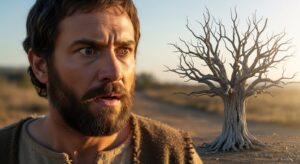
Tuesday morning. The sun rises over the Mount of Olives. The group is heading back into Jerusalem.
Peter is likely in the lead. He rounds the corner where the lush green tree stood just twenty-four hours ago.
He stops. His jaw drops.
“Rabbi!” he shouts, pointing a trembling finger. “Look! The fig tree you cursed has withered!”
This wasn’t a normal wilting. When a tree dies, it usually dies from the top down. The leaves brown, the branches dry out, and finally, the trunk rots.
But the Bible says this tree was withered from the roots. In one day, Jesus had reached into the unseen realm and severed the life-source of that tree. It stood there like a skeleton. A monument to the power of His word.
Why did He do it?
Because Jesus wanted His disciples to understand a terrifying and beautiful truth: His word has the power to create, but it also has the power to judge.
If He says a thing is dead, it is dead. If He says a person is forgiven, they are forgiven.
If you believe in the power of Jesus’ word to change your life, type “AMEN” in the comments. Let’s fill the comment section with faith!
But the story doesn’t end with a dead tree. It ends with a lesson on how YOU can move mountains.
CHAPTER 6: HOW TO MOVE MOUNTAINS
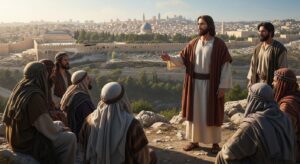
The disciples are staring at the dead tree, but Jesus is already moving to the next lesson. He doesn’t apologize for killing the tree. He doesn’t even explain the “parable” part yet.
Instead, He says something that has been quoted by every preacher for two millennia:
“Have faith in God. Truly I tell you, if anyone says to this mountain, ‘Go, throw yourself into the sea,’ and does not doubt in their heart but believes that what they say will happen, it will be done for them.”

Think about the audacity of that statement. He just killed a tree with a word, and now He’s telling them they can move continents with theirs.
But there’s a catch.
Most people use this verse like a magic spell. They think if they just “believe” hard enough, they can get a new car or a promotion.
But look at the context!
Jesus had just judged hypocrisy. He had just cleared the Temple. He had just cursed the “fake” life of the fig tree.
The “Mountain” He was talking about wasn’t just a pile of rocks. He was likely pointing at the Temple Mount—the “Mountain” of corrupt religious authority that stood in the way of the people and God.
He was telling them: “The old system is a mountain. It looks immovable. But through faith, it will be cast into the sea of history.”
What is the “mountain” in your life right now? Is it an addiction? A broken marriage? A fear that keeps you awake at 3:00 AM?
Jesus is telling you: Don’t look at the mountain. Look at the One who can wither a fig tree from the roots.
If this is speaking to you, hit that LIKE button 👍 right now. It helps this message reach someone else who is facing a mountain today.
CHAPTER 7: THE SECRET INGREDIENT (THE TWIST)
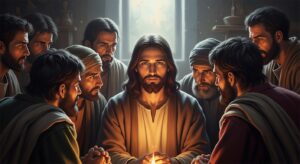
(Visual: Soft, warm lighting. Jesus looking directly into the eyes of His disciples.)
Now, here is the part of the script that most people skip.
Right after Jesus tells them they can move mountains, He gives them a condition. It’s the “Retention Hack” for your soul. If you want this power, you have to do one thing that is harder than moving a mountain.
He says: “And when you stand praying, if you hold anything against anyone, forgive them, so that your Father in heaven may forgive you your sins.”
Wait… what?
We went from cursing trees and flipping tables to… forgiveness?
Why?
Because Jesus knew that the greatest “barrenness” in the human heart isn’t a lack of money or a lack of fame. It’s unforgiveness.
Unforgiveness is the “leafy branch” that hides a rotten heart. You can go to church, you can sing the songs, you can “look” like a fig tree in full bloom—but if you have bitterness in your roots, you are withered in the eyes of God.
Jesus was saying:
“I have the power to judge. You don’t. Your job is to believe and to forgive.”
CHALLENGE: Is there someone you need to forgive? You don’t have to like what they did, but you have to let go of the debt. If you are ready to let go, type “I forgive” in the comments. It’s a private declaration between you and God, but it starts with a step of faith.
CHAPTER 8: THE WARNING FOR TODAY
(Visual: Fast cuts between ancient ruins and modern cityscapes—skyscrapers, social media icons, busy people.)
This story isn’t just a history lesson. It’s a mirror.
We live in the “Age of the Fig Tree.”
We are obsessed with “leaves.” We curate our Instagram feeds to look perfect. We “perform” our lives for an audience. We want the appearance of success, the appearance of happiness, the appearance of holiness.
But when the Master comes looking for fruit… what does He find?
Does He find the fruit of the Spirit? Love, joy, peace, patience, kindness? Or does He just find more “leaves”?
This is the “FOMO” of the soul—the Fear of Missing Out on the real life God has for you because you’re too busy pretending.
The fig tree died because it was a hypocrite. It claimed to have something it didn’t.
But here is the “Hope Trigger”: You don’t have to be a fig tree. You can be a branch on the Vine.
Jesus said in John 15: “I am the vine; you are the branches. If you remain in me and I in you, you will bear much fruit.”
The difference is simple:
The Fig Tree tried to produce on its own.
The Branch just stays connected to the Source.
(Visual: A beautiful vineyard with heavy clusters of grapes.)
Are you tired of trying to “look” like a Christian? Are you tired of the “leaves”?
Then stop trying to grow fruit and start trying to grow closer to Jesus. The fruit happens naturally when the connection is real.
CHAPTER 9: THE ULTIMATE TAKEAWAY
As we wrap up this journey through Mark chapter 11, let’s look at the final moral.
Jesus didn’t kill the tree because He was “hangry.” He didn’t kill it because He was mean.
He killed it because He loved His disciples too much to let them become fake. He wanted them to know that in the Kingdom of God, reality is everything.
He is a King who deserves more than “leaves.” He deserves your heart.
Within a few days of this miracle, Jesus would be hung on a different kind of tree. Not a green fig tree, but a rugged wooden cross.
On that tree, He took the “curse” that we deserved. He became the “withered” one so that we could be the “fruitful” ones.
He died from the roots of our sin so that we could live from the power of His resurrection.
If this story has touched you, please do three things:
SHARE this story with someone who needs to hear that God wants their heart, not their performance.
COMMENT “Amen” or share your favorite verse about faith.
Where are you reading from today? We love seeing how far the Word of God is traveling. Drop your city or country below!