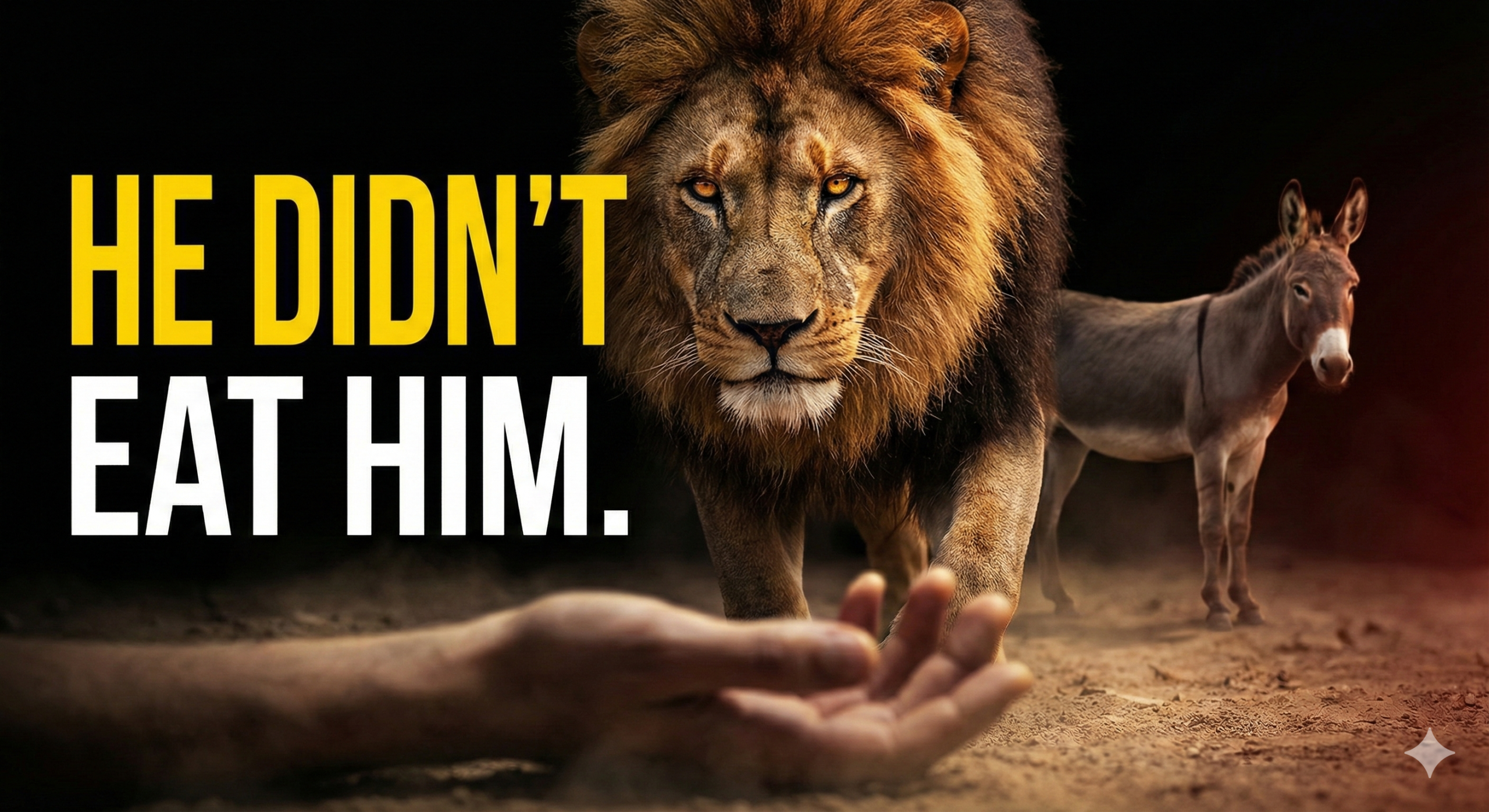
It is one of the most haunting images in the entire Bible. A lion. A donkey. And a dead man.
In the wild, a lion kills to eat. It tears, it devours, and it scatters the prey. But this lion? This lion stands like a sentinel. It has not eaten the body. It has not mauled the donkey. It is standing guard over a man who just hours ago performed one of the greatest miracles in the history of Israel.
He was a man who stared down a tyrant King. He was a man who withered a hand with a single word. He was a man who held the power of God in his mouth.
But he made one mistake. One moment of weakness. One bite of bread. One sip of water.
And because of that single act of disobedience, God sent a lion not to hunt him, but to execute him.
Why? Why would a God of mercy kill a faithful servant for eating a meal? Why would God allow a lying prophet to deceive a righteous one?
This story will challenge everything you think you know about obedience, discernment, and the terrifying holiness of God. It is a story of political treason, spiritual warfare, and a judgment so precise it could only come from heaven.
If you are ready to uncover the mystery of the Prophet and the Lion, hit that SUBSCRIBE button right now. We are about to walk down the dusty roads of ancient Bethel, and you do not want to miss a single step of this journey. Turn on notifications, because what you are about to hear might just change the way you walk with God.
To understand the death of the prophet, we must first understand the sin of the King.
The year is approximately 930 BC. The unimaginable has happened. The great Kingdom of David and Solomon has been torn in two. Civil war has fractured the people of God. In the South, Rehoboam rules over Judah from Jerusalem. But in the North, a new king has risen: Jeroboam.
Jeroboam was a man of promise. God had actually given him the ten tribes. But Jeroboam had a problem. He had a deep, gnawing insecurity.
He looked at his people and thought, “If these Israelites go down to Jerusalem to worship at the Temple of the Lord, their hearts will turn back to the house of David. They will kill me and return to the South.”
Fear. Fear is the architect of heresy.
So, Jeroboam did the unthinkable. He didn’t just build a wall; he built a new religion. He took counsel—not from God, but from his own paranoia—and he fashioned two calves of gold. He placed one in Dan, in the far north, and the other in Bethel, just miles from the border of Judah.
Can you smell the incense? Can you hear the chanting? It looked like worship, but it was rebellion. Jeroboam told the people, “It is too much for you to go up to Jerusalem. Here are your gods, O Israel, who brought you up out of Egypt.”
He appointed priests who were not Levites. He changed the feast days. He created a counterfeit kingdom. And at the center of it all was Bethel—the “House of God”—now turned into a house of idols.
God watched from heaven. The silence was deafening. But God never stays silent forever.
Let me ask you a question before we meet our hero. Have you ever seen someone change their beliefs just to keep their power or their popularity? It happens in politics, it happens in business, and sadly, it happens in the church. Comment below: “TRUTH” if you believe we must stand on God’s word no matter the cost.
While Jeroboam was celebrating his new religion, God was stirring a man in the South. We don’t know his name. The Bible simply calls him “The Man of God from Judah.”
Names imply identity, but this man had given up his identity for his mission. He was an arrow shot from the bow of the Almighty, aimed straight at the heart of Bethel.
But this mission came with terrifyingly specific instructions. God didn’t just tell him what to say; He told him how to survive.
“You shall eat no bread, nor drink water, nor return by the way that you came.”
Pause for a moment. Why? Why such a strict diet? Why hunger and thirst?
Because to eat with someone in the ancient Near East was to have fellowship with them. To break bread was to accept their hospitality, their culture, and their validity. God was saying: “This place is radioactive with sin. Do not taste it. Do not swallow it. Do not even leave footprints in the same dust twice. Deliver the message, and get out.”
The Man of God strapped on his sandals. He set his face like flint. He walked out of the safety of Judah and crossed the border into the idolatrous North. He was walking into a lion’s den—metaphorically, for now.
He arrives at Bethel. The festival is in full swing. The noise is overwhelming. King Jeroboam stands by the altar, incense in hand, feeling invincible. He is the King. He is the High Priest of his own religion.
Suddenly, the crowd parts. The music falters.
A stranger steps forward. He doesn’t bow. He doesn’t tremble. He looks past the King, straight at the altar of stone and gold.
This is the moment of confrontation. The moment where faith meets force. If you love stories of courage, take a second to hit that LIKE button. Let’s get this video to 10,000 likes for the courage of the prophets!
The Man of God opens his mouth, and he cries out—not to the King, but to the structure itself.
“O altar, altar! Thus says the Lord: ‘Behold, a son shall be born to the house of David, Josiah by name; and on you shall he sacrifice the priests of the high places who burn incense on you, and men’s bones shall be burned on you.’”
Listen to the specificity! He names a king—Josiah—who wouldn’t be born for another 300 years! This wasn’t a guess; this was divine foreclosure.
And then, he gives a sign. “This is the sign the Lord has spoken: The altar shall be torn down, and the ashes on it shall be poured out.”
King Jeroboam snaps. This stranger is humiliating him in front of his subjects. The King stretches out his hand—the hand that holds the scepter, the hand of authority—and he screams, “Seize him!”
In an instant, the King’s scream turns into a gasp of horror.
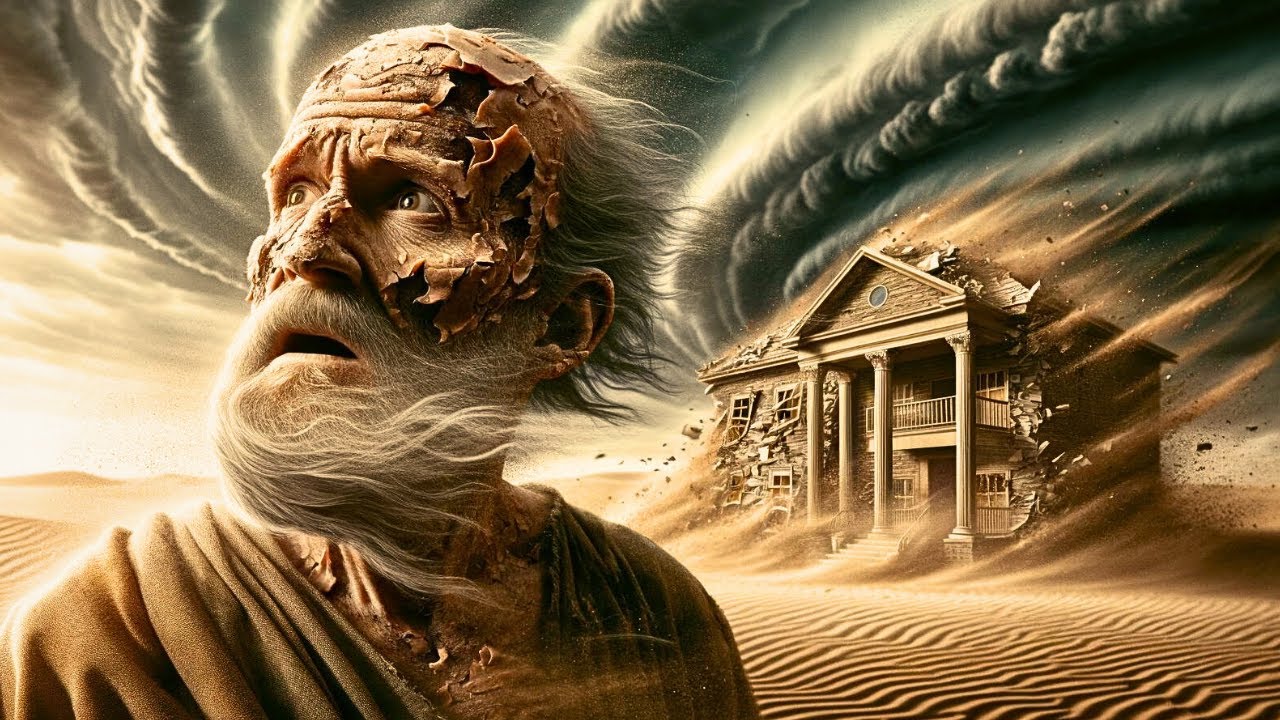
As he points at the prophet, his arm freezes. It stiffens. The muscles wither, the skin dries up like old parchment. He tries to pull it back, but he can’t. His arm is stuck, pointing accusingly at the prophet, a dead branch attached to a living body.
At that exact second—Crack!
The massive stone altar splits down the middle. The expensive incense, the holy ashes, the golden sacrifice—it all spills into the dirt.
The festival is over. The gods of gold are silent. The King is paralyzed.
Imagine the silence in that square. The King, who thought he was a god, is now begging a man he tried to arrest.
“Entreat now the favor of the Lord your God, and pray for me, that my hand may be restored to me.”
Do you see the irony? He doesn’t pray to his golden calves. When real trouble hits, the idols are useless. He begs the prophet of the true God.
Friends, when life falls apart, nobody calls on the world for help. We call on the One who made us. Jeroboam learned the hard way that his power was an illusion.
The Man of God prays. He doesn’t gloat. He shows mercy. The King’s hand is restored.
But now comes the real test. The test that is harder than persecution. The test of prosperity.
The King looks at the prophet. He sees power. And kings always want to buy power.
Jeroboam says, “Come home with me, and refresh yourself, and I will give you a reward.”
This is the trap. It’s subtle. It’s not a threat; it’s an invitation. Come to the palace. Eat the King’s food. Take the King’s money. If the prophet accepts, he validates the King’s idolatry. He becomes a paid employee of the state.
But the Man of God remembers the command. He looks the King in the eye and says:
“If you gave me half your house, I would not go in with you. And I would not eat bread or drink water in this place. For so was it commanded me by the word of the Lord.”
He turns his back on the King. He turns his back on the money. He turns his back on the fame. And he walks away.
He passed the test! He defeated the enemy! He is walking home victorious! If the story ended here, it would be a triumph. Type “AMEN” in the comments if you want the strength to say NO to temptation!
But the story doesn’t end here. The most dangerous enemy isn’t the angry King in the palace. The most dangerous enemy is waiting for him in the shadows. And this enemy doesn’t carry a sword. He carries a Bible… and a lie.
Now dwells an old prophet in Bethel.
Notice the text. He is old. He lives in Bethel, the center of idolatry. Why is he still there? If he is a true prophet of God, why didn’t he speak out against the golden calves? Why did it take a man from Judah to do his job?
Perhaps he was retired. Perhaps he was compromised. Perhaps he had grown comfortable in the midst of sin.
His sons come home and tell him everything: the altar splitting, the withered hand, the refusal to eat.
Something triggers in the Old Prophet. Is it jealousy? Is it conviction? Is it a desperate need to reconnect with the power of God he hasn’t felt in years?
He asks, “Which way did he go?”
He saddles his donkey. He rides hard. He hunts the Man of God down.
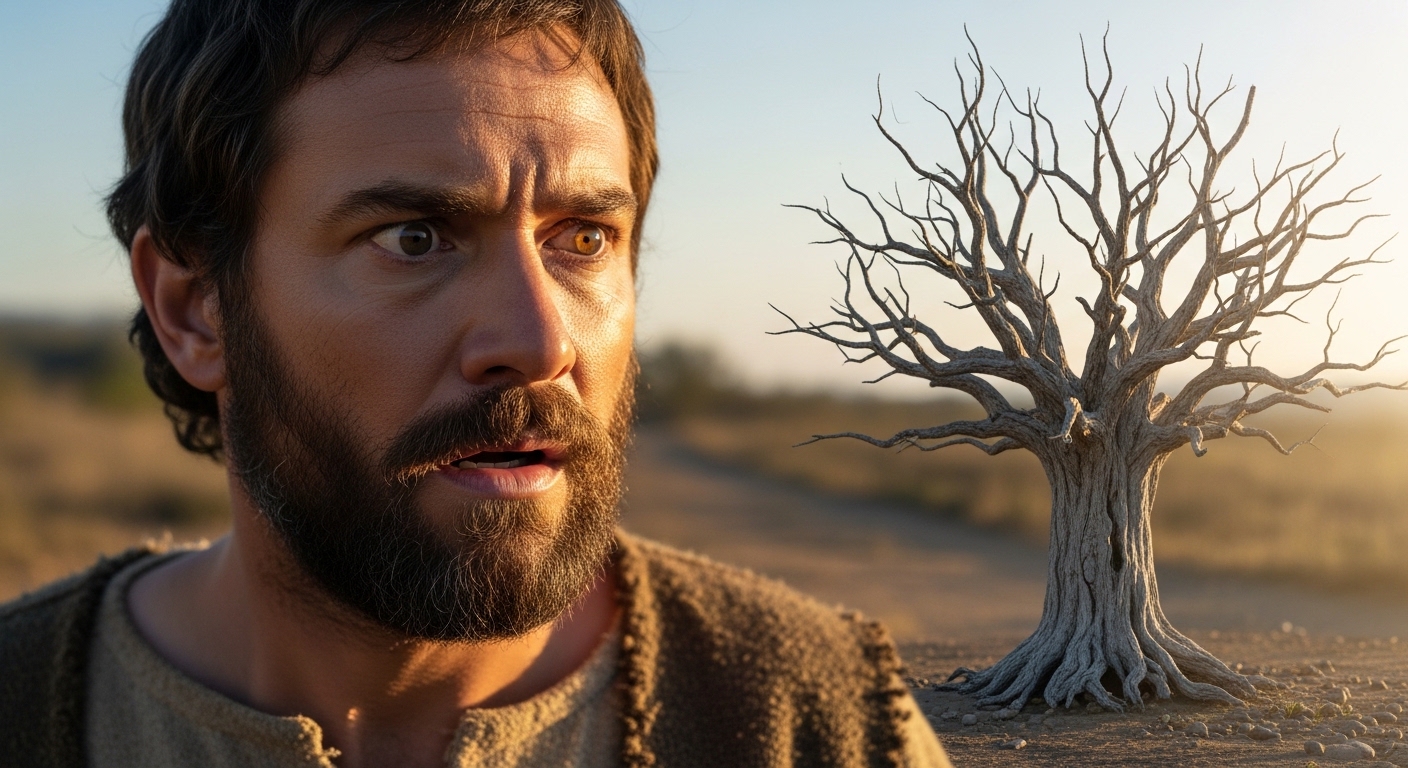
He finds the Man of God sitting under an oak tree.
Listen to me closely: This is the first mistake. The command was “Do not return by the way you came.” It implied continuous movement. Get in, get out. But the Man of God stopped. He loitered. He sat down in enemy territory.
The Old Prophet rides up. He looks kind. He looks like a brother in the faith. He says, “Come home with me and eat bread.”
The Man of God refuses again. He repeats God’s command perfectly. “I cannot return with you, nor eat bread, nor drink water in this place.”
And then… the Old Prophet drops the bomb. The sentence that destroys a destiny.
He looks the Man of God in the eyes and says:
“I also am a prophet as you are. And an angel spoke to me by the word of the Lord, saying, ‘Bring him back with you into your house that he may eat bread and drink water.’”
The Bible adds one devastating parenthetical phrase:
“(But he lied to him.)”
Put yourself in the Man of God’s sandals. You are hungry. You are thirsty. You are exhausted. Here is an older, respected prophet. He claims an angel spoke to him. It’s what you want to hear. It validates your fleshly desire for comfort.
What would you do? Would you trust the fresh “word” from the angel? Or would you stick to the “old” word God gave you directly?
The Man of God… got up. He turned around. And he followed the liar back to Bethel.
He ate the bread. He drank the water. He violated the direct command of the Almighty.
He thought he was safe. He thought, “Surely God understands. A fellow prophet told me it was okay.”
But God is not a God of confusion.
Suddenly, the atmosphere in the room changes. The Old Prophet—the one who lied—starts to shake. The Spirit of the Lord seizes him. God hijacks the mouth of the liar to speak the truth to the disobedient.
The Old Prophet cries out:
“Thus says the Lord: ‘Because you have disobeyed the word of the Lord and have not kept the command that the Lord your God commanded you… your body shall not come to the tomb of your fathers.’”
Silence.
The bread turns to ash in his mouth. The water tastes like judgment.
The Man of God realizes what he has done. He let his guard down. He trusted a man over God. He accepted a “new revelation” that contradicted the original command.
There is no begging for mercy this time. No withered hand to restore. The verdict has been read. The Man of God finishes his meal in silence. He saddles his donkey. He rides out of Bethel.
He knows. He knows he is a walking dead man.
He didn’t make it to Judah.
Somewhere on the road, out of the thicket, a blur of tawny fur exploded onto the path.
It wasn’t a pack of wolves. It wasn’t bandits. It was the King of Beasts.
The attack was swift. The lion struck the Man of God. One blow. Life extinguished.
But then, the miracle happened.
Any natural lion would have torn the body apart. It would have dragged the carcass into the bushes. It would have attacked the donkey, which is natural prey.
But passersby stopped in their tracks, their mouths gaping in fear and wonder.
The lion stood there. It was under orders. It was a divine supernatural agent. It had fulfilled its contract.
The donkey stood there, unharmed.
The man lay there, dead.
It was a billboard for the holiness of God. It shouted to everyone walking by: “God is not to be trifled with. His word is absolute.”
This is a terrifying scene. It shows us that God’s standard for leaders is incredibly high. If this story is shaking you up, share this video with a friend who needs to hear it. We need to wake up to the holiness of God!
News reached Bethel. “There is a lion standing over a body, but not eating it.”
The Old Prophet knew. He said, “It is the man of God who disobeyed the word of the Lord.”
He went to the spot. The lion allowed the Old Prophet to approach. It didn’t attack him. Its job was done. The lion disappeared into history, leaving the Old Prophet with the weight of his guilt.
The Old Prophet took the body. He laid it on his own donkey. He brought him back to the city to mourn.
He buried him in his own grave. And he cried out over him, “Alas, my brother!”
What a tragedy. The man who deceived him now mourns him. The Old Prophet commands his sons: “When I die, bury me in the grave with the man of God. Lay my bones beside his bones. For the saying that he cried out against the altar in Bethel shall surely come to pass.”
Even in death, the Man of God’s testimony stood. His prophecy against the altar was true, even if his life ended in failure.
So, what do we do with this story? It’s harsh. It feels unfair.
But here is the spiritual reality: Partial obedience is disobedience.
The Man of God stood up to a King, but he fell to a peer. He survived the lion’s den of the palace, but was killed by a lion on the road because he relaxed his guard.
He allowed a human voice to override the voice of God.
In our world today, there are many voices. Voices that say, “Did God really say that?” Voices that say, “Times have changed, come eat bread with us, come compromise with the culture.” Even voices that claim to have “new revelation” from angels.
But if an angel from heaven preaches any other gospel than the one you have received, let him be accursed. That is what the Apostle Paul said. The Man of God in 1 Kings 13 forgot that lesson.
God is loving, yes. But God is a consuming fire. He desires obedience more than sacrifice.
The lion stands as a warning to us all. Finish the race. Don’t stop under the oak tree. Don’t go back to Bethel. Keep your eyes on the road to Judah, and hold fast to the Word of God until the very end.
But this isn’t the only time a prophet faced a beast, or a King faced judgment. If you think this judgment was terrifying, wait until you hear the story of the man who was eaten by worms while sitting on his throne.
If this story moved you, I want you to type “I Will Obey” in the comments below. Let it be your declaration today.
Go in grace, walk in truth, and beware the lion on the road.